
Kakobuy consolidation: what one parcel saves over two
Every parcel you send starts again at the first-weight price and carries its own fixed charges. Consolidating in China is free, and can avoid repeated minimum charges. The result depends on the line, size and goods restrictions.
Consolidating into one parcel
- At stake on the reference order
- US$16.48 for one avoided split on a 1 kg US parcel, using the help centre's own EMS example tariff and its ¥8 per-parcel declaration charge.
- The part you control
- When you submit, which items wait for which, and whether same-seller items go on one purchase order.
- Where it trades places with the next lever
- On a US 1 kg parcel it edges out line choice (US$16.48 against US$14.73). For the UK, Germany and France, line choice comes first.
- 1Exchange rateUS$24.48
- 2ConsolidationUS$16.48
- 3Shipping lineUS$14.73
- 4Top-up channelUS$12.57
- 5Add-onsUS$5.49
Consolidation arithmetic from the help centre's own example
The courier-fee section of the help centre works one example through. EMS to the United States at 160 RMB for the first 500 g, 55 RMB for each further 500 g, plus a 4 RMB operation fee. Three items weighing 500 g, 1,200 g and 2,100 g sent separately cost 164, 274 and 384 RMB: 822 RMB in total.
In the old EMS illustration, combining the three items into 3,800 g produces a 549 RMB bill rather than 822 RMB. That demonstrates repeated first-weight charges; it is not a current EMS quote. Whether a combined parcel saves money today also depends on its packaging, dimensions, contents and eligible route.
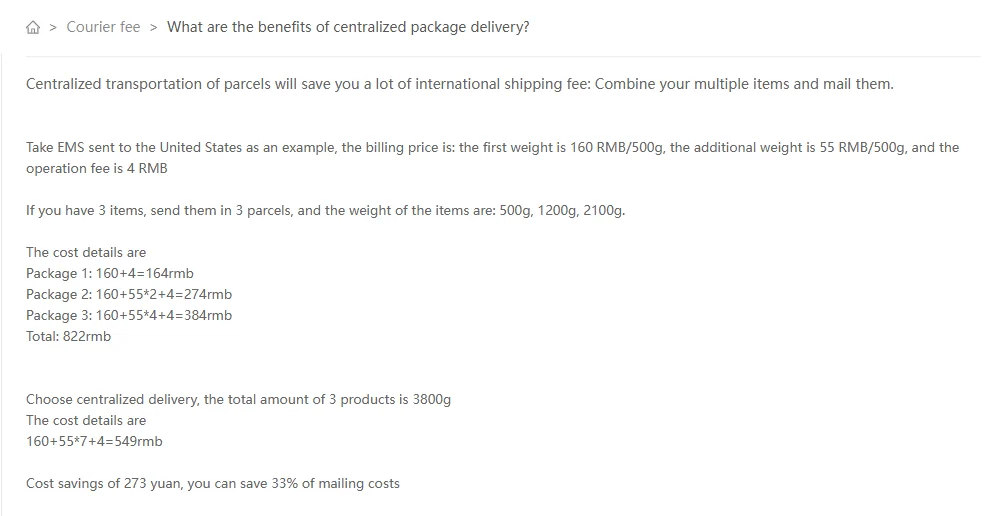
Our reference order uses the same tariff for a smaller case: 1.0 kg as two 500 g parcels costs 328 RMB, as one parcel 219 RMB. Add the declaration charge the second parcel would carry and one avoided split is worth US$16.48.
Domestic delivery: one fee per seller order
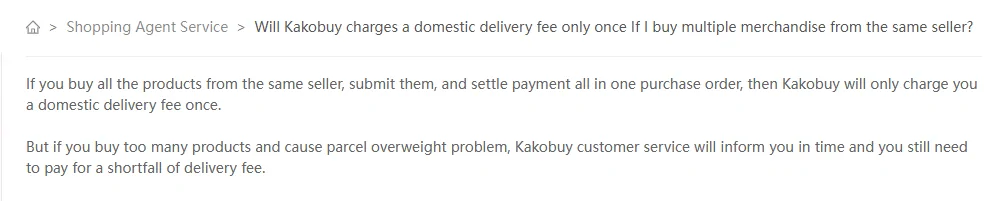
Consolidation starts before the warehouse. The help centre says that if you buy all your products from one seller, submit them and pay in one purchase order, the domestic delivery fee is charged once. Buy the same items from that seller in three separate orders and you can pay domestic delivery three times.
The same article adds a catch: if the combined order is heavy enough to exceed the seller's shipping weight, customer service will ask you to pay the shortfall. That is not a penalty, just the seller's real postage.
The reference order assumes ¥45 of domestic delivery across three sellers. In a real basket, compare the seller’s combined-order quote before paying. Same-seller items can share a domestic-delivery charge under the captured rule, but a heavier order or a later separate purchase can change that amount.
Per-parcel charges that do not shrink with weight
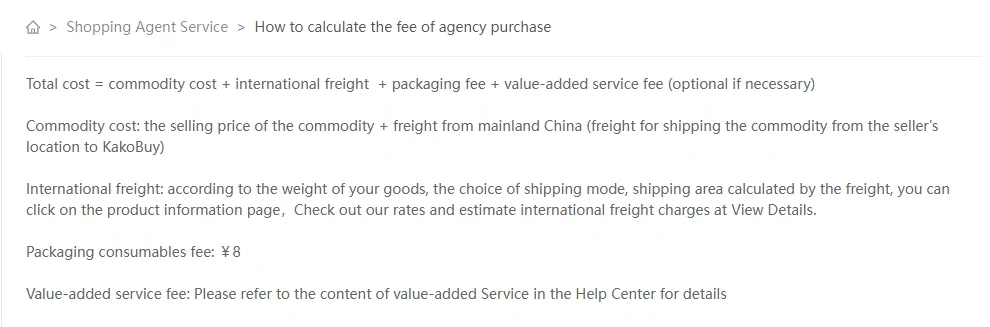
Two flat charges appear in the help centre, in different articles. The charging article lists a customs declaration cost of generally RMB 8.00 per parcel, depending on the shipping method. The fee-calculation article lists a packaging consumables fee of ¥8.
The help centre never says whether these are the same charge described twice or two separate charges, and we have not seen an invoice that settles it. So our calculator counts only the declaration charge per extra parcel, as a dated scenario assumption. We do not add both ¥8 entries together. Confirm the actual per-parcel breakdown before comparing shipments.
Volume weight: when a bigger box costs more than a heavier one
Consolidating does not always shrink the bill in proportion. The help centre defines volume weight as length times width times height in centimetres divided by 5,000, or by 6,000, 7,000 or 8,000 depending on the carrier, and lines priced on volume charge whichever is larger: real weight or volume weight. Some UK lines on the estimator showed the 8,000 divisor.
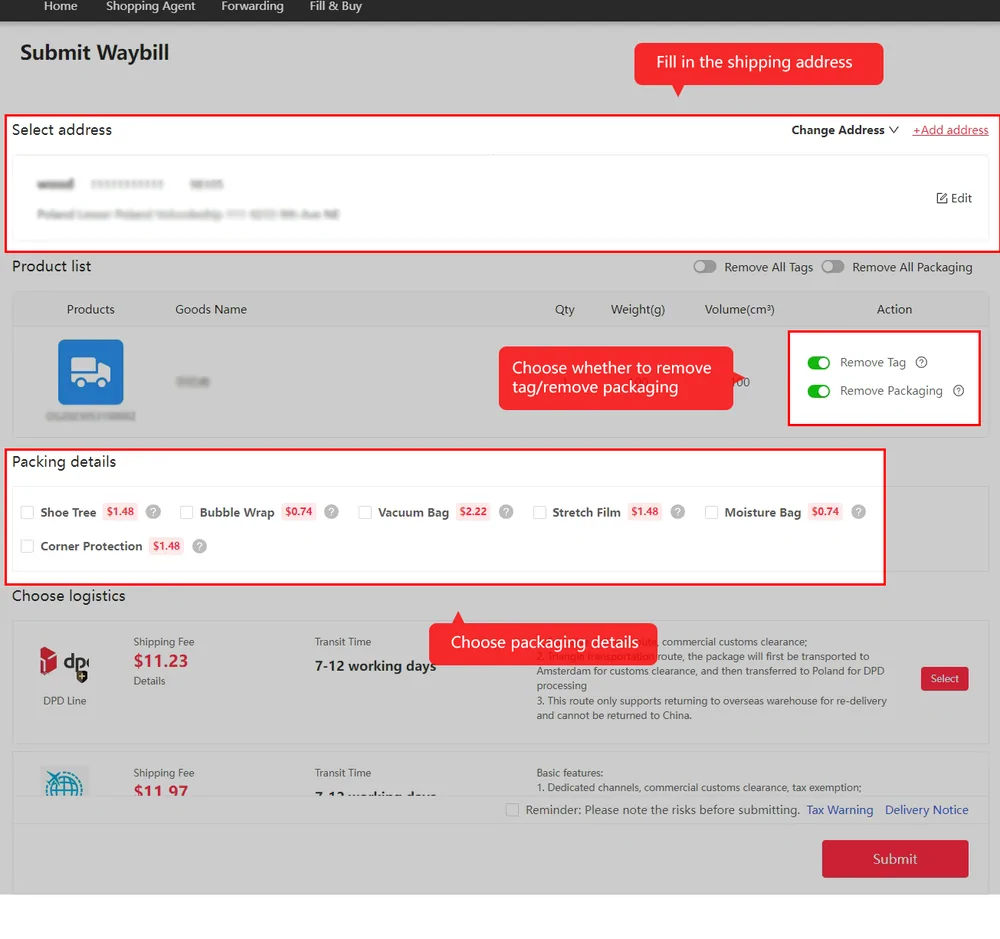
A combined box can create a different volumetric charge from separate parcels. Before removing shoe boxes or outer packaging, decide whether you need the box, labels or protection. Ask for the packed dimensions of the intended arrangement; volume reduction is useful only if it changes the chargeable band or eligible route.
The waiting cost: the 100-day storage clock
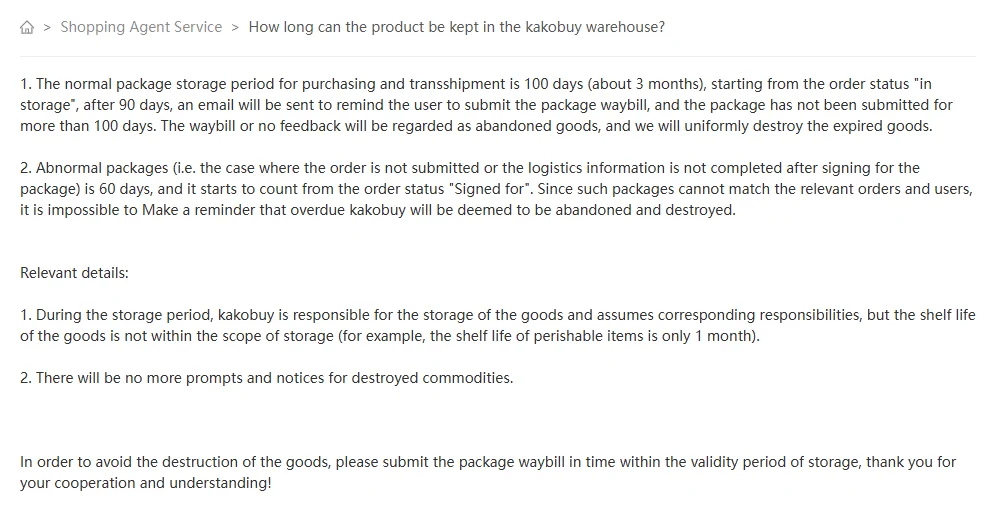
Consolidation means the first item to arrive waits for the last. The help centre gives normal packages 100 days of free storage, counted from the in-storage status, and sends a reminder email after 90 days. Do not plan to ship after the free period without arranging an eligible extension. A separately described cooling-off period is not a guaranteed extra free month.
The captured extension is ¥10 per OG order number per 30 days, subject to eligibility and confirmation. Count order numbers rather than assuming each physical item or parcel is one extension. Abnormal parcels have a separate 60-day storage rule. Set the waiting cut-off from the earliest actual deadline and the next seller update, not an arbitrary number of weeks.
When not to consolidate
A few situations make one big parcel the wrong call:
- Large or repeated-item parcels. The old help page warns about heavy parcels and many identical items. Its example is not a universal customs threshold or a guarantee that a lighter parcel is personal use.
- Weight-capped lines. EUB to the US was marked with a 2 kg actual weight limit on the estimator, with 2,150 g estimated weight allowed for submission. Go over and you have to choose another line.
- Mixed batteries and liquids. One battery item can rule out every no-battery line for the whole parcel. Sometimes two parcels on two cheaper lines beat one parcel on a battery-accepting line.
- Very different arrival dates. When one item sits for weeks, the extension fees eat the saving.
In each case the test is the same: price both options in the estimator before you submit.
Next lever down: Shipping line, worth US$14.73 on the reference order
Make the waiting decision item by item
List each item’s storage start date, return deadline and seller status. The oldest item sets the practical deadline. Compare an eligible extension or a separate shipment with the cost of waiting; do not sacrifice a return opportunity just to complete one large parcel.
A mixed basket can justify two parcels
Suppose your basket contains ordinary clothing and a battery-powered item. First ask which routes accept the exact battery type and the full combined contents. Then compare a combined eligible shipment with separate clothing and battery quotes, using realistic packed dimensions for each.
Add the actual applicable parcel charges, the packing services you need and any storage extension caused by waiting. Do not reuse the ¥16.48 reference saving as the answer: that number assumes an old EMS tariff and one illustrative fee. Compare quotes for the same intended parcels before choosing a split.