
Kakobuy exchange rate: compare the conversion cost
A zero standard service-fee headline does not remove conversion costs. Compare the yuan price with the amount charged in your payment currency, then check the separate payment-channel fee.
The exchange-rate markup
- At stake on the reference order
- US$24.48 on ¥2,045 of goods and domestic delivery, at the 8.5% markup independently measured on 8 October 2026.
- The part you control
- Whether the conversion happens once or twice, which currency you pay in, and which agent you use. Not the rate itself.
- Where it trades places with the next lever
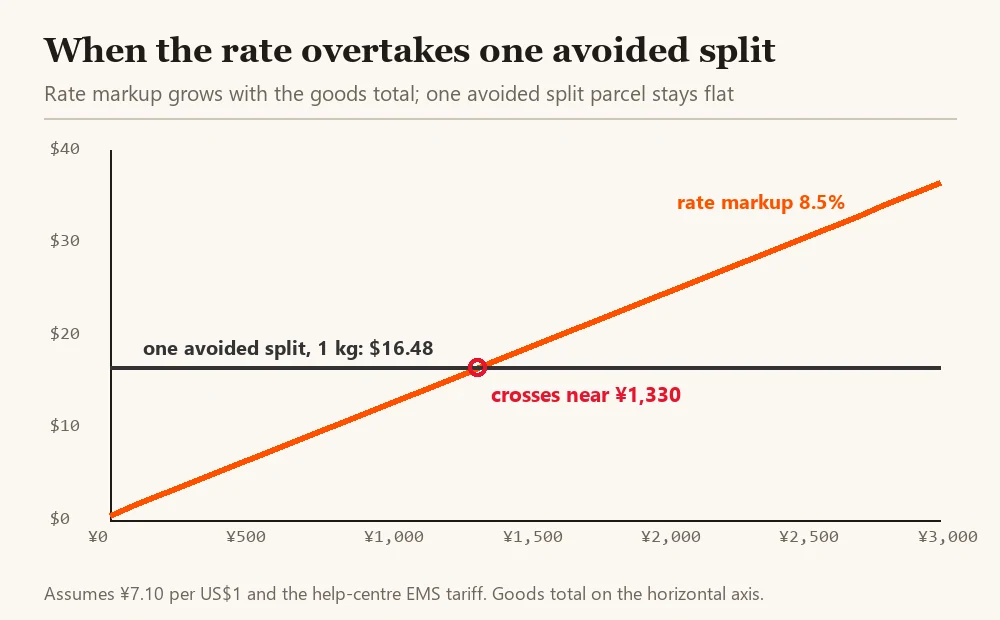
- Below about ¥1,330 of goods, one avoided split parcel on a 1 kg order is worth more than the whole markup.
- 1Exchange rateUS$24.48
- 2ConsolidationUS$16.48
- 3Shipping lineUS$14.73
- 4Top-up channelUS$12.57
- 5Add-onsUS$5.49
How the exchange rate is set on Kakobuy
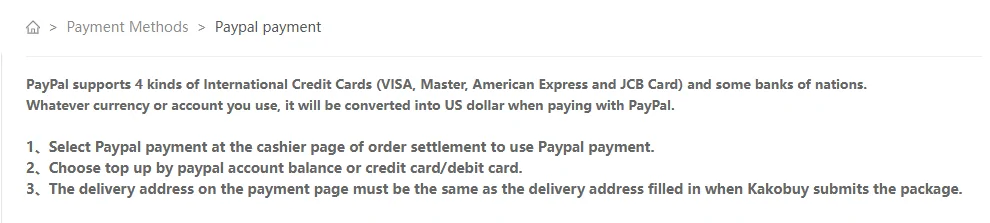
Prices on Kakobuy start in yuan, because that is what the Chinese seller charges. When you switch the display to dollars, euros or pounds, the site converts. The recharge article in the help centre says the rate is adjusted according to the latest one published by Bank of China, and that PayPal top-ups, whatever card or currency you use, are converted into US dollars.
That gives two separate conversions to think about. One is Kakobuy's own yuan-to-dollar rate, which applies to everything you pay. The other is PayPal's conversion from your home currency into US dollars, which only applies if you top up by PayPal from a non-dollar account. The dated all-in margin measurement covers conversion markup plus standard service fees; it does not include the separate PayPal surcharge. The second depends on your PayPal account and we do not put a number on it.
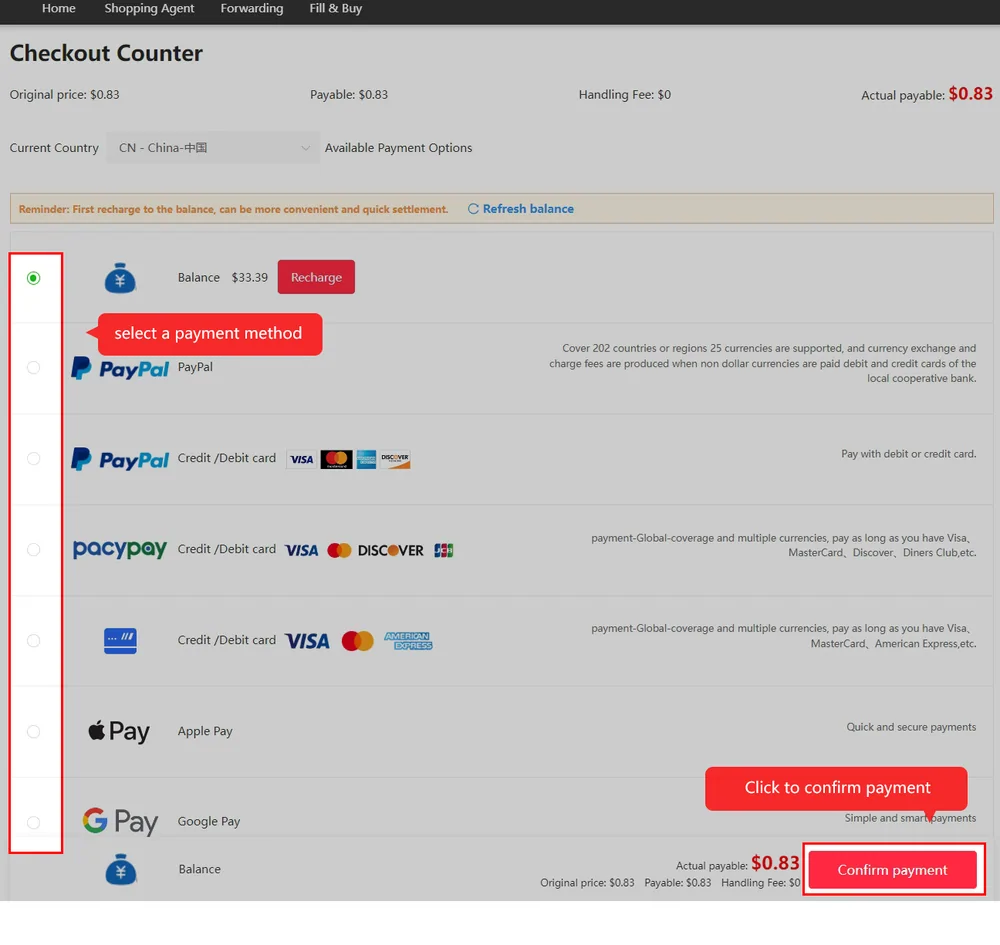
Check the currency of the actual provider debit and card account. A dollar-denominated card may avoid one conversion when the provider also debits dollars, but the selected provider settings and charges still matter. Do not infer the settlement currency solely from Kakobuy’s display setting.
What the exchange-rate markup costs at different order sizes
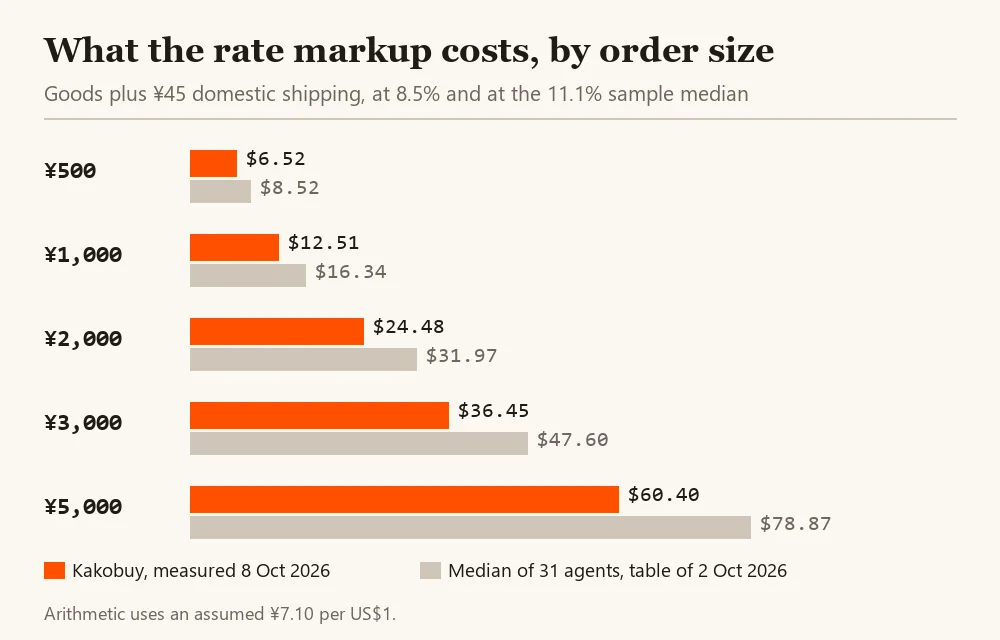
A percentage markup scales with the yuan total. It does not care how heavy the parcel is or how many sellers you bought from. That is why it leads the ranking on larger orders and slips down on small ones.
At 8.5% the markup costs about US$6.52 on ¥500 of goods, US$12.51 on ¥1,000, US$24.48 on ¥2,000 and US$60.40 on ¥5,000, each with ¥45 of domestic delivery added and converted at our assumed ¥7.10. The grey bars show the same orders at the 11.1% median of the wider sample.
These are not savings. They are the size of a cost that is already in your bill. The point of measuring it is to know how big it is next to the things you can change.
Comparing exchange rates across agents without ranking them
A table updated on 2 October 2026 measured all-in markups for 31 agents that publish enough to measure. The spread ran from 0.4% to 18.1%, with a median of 11.1%. Kakobuy's figure, measured again on 8 October 2026, was 8.5%.
We print those figures with their dates and stop there. A rate measured on one day is a single fact, not a verdict on an agent, and it can change the following week. Nor does a lower markup settle anything by itself: an agent with a lower rate may charge more for freight or storage.
For your own comparison, record the yuan amount being purchased or credited and the actual debit before confirmation. Compare that with a reference rate at the same time, then list any separately charged provider fee. A rounded product-display price can suggest a question but is not a complete payment-cost measurement.
Separate conversion cost from repeat payment fees
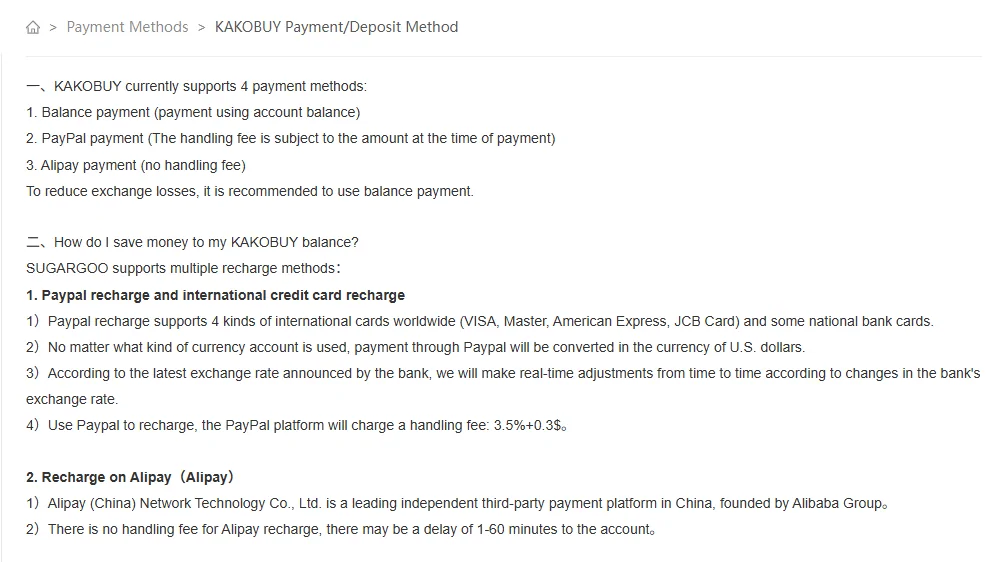
This is the part of lever one you control. Kakobuy's deposit-method article lists balance, PayPal and Alipay as ways to pay, and then says, in so many words, that balance payment is recommended to reduce exchange losses.
Separate payments can incur separate fixed charges, but consolidating top-ups does not erase percentage fees or guarantee a better conversion rate. Compare the total paid and balance credited, and avoid leaving an unnecessary balance solely to save a small fixed fee.
One honest caveat: the same article's second heading says another agent's name where Kakobuy's should be. It reads like a copied template. The advice itself is consistent with the recharge article, so we treat it as Kakobuy's own, but it is a reminder that help-centre text is not always edited closely.
When the exchange rate stops being the largest lever
On a 1 kg parcel, one avoided split is worth about US$16.48 with the help centre's EMS example tariff. The markup only passes that once your goods total is above roughly ¥1,330. Below it, the order of the first two levers swaps.
Destination matters too. For the United Kingdom, Germany and France, the gap between the lowest and highest bookable 1 kg line on 10 October 2026 was US$38 to US$48, larger than the markup on our ¥2,000 reference order. If you ship to those countries, read the shipping-line page as if it were lever one.
What a zero service fee does and does not mean
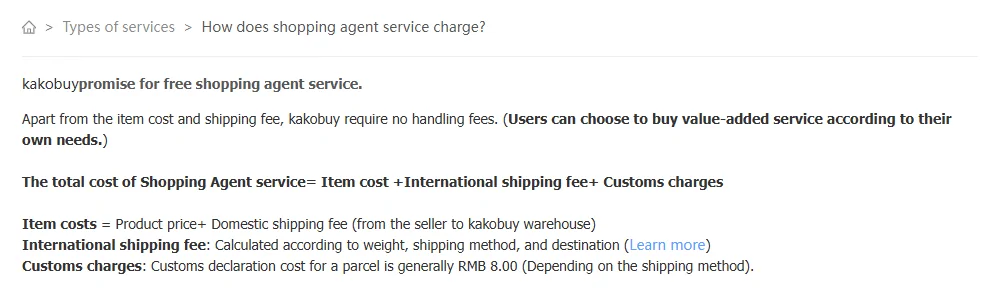
The help centre's charging article says Kakobuy requires no handling fees apart from the item cost and shipping, and lists the total as item cost, international shipping and customs charges, with a customs declaration cost of generally RMB 8.00 per parcel. That is accurate as far as it goes.
What it leaves out is that the conversion rate is where agents without a service fee earn. Most agents in the measured sample also charge no service fee on standard platforms, which is exactly why the rate is the number worth comparing. Treat any headline about zero fees as the start of the sum, not the end of it.
Next lever down: Consolidation, worth US$16.48 on the reference order
Use the same moment and the same amount
Write down the yuan amount, the foreign-currency debit and the credited balance from the same quote. Calculate an effective rate from those amounts, then record any separate channel fee. A display-currency conversion alone may not describe the full payment path.
Keep one comparison row per payment method
Record five things together: yuan value credited, amount debited, debit currency, separately listed fee and time. A quote that includes the fee must not have that fee added again. Repeat with the same yuan amount when comparing another service.
The retained table gives Kakobuy 8.5% in both its FX and combined-cost columns because its standard service fee is listed as zero. Other agents’ combined columns may include a standard fee, so the sample median is not a pure-FX benchmark for every provider. Read the separate payment-method costs before interpreting the gap.